Blank Mind Map for Kids: How to Make One That Works
A blank mind map for kids needs a big center and just a few thick branches. Here is how to make one for any age, plus a worked example of a school report.

A blank mind map for kids is a page with one circle in the middle and four to six empty branches around it, big enough for a child to write or draw one idea per branch. That is the whole template. Kids don’t need decorated worksheets with twelve tiny bubbles; they need a few large spaces, a clear center, and permission to fill them in any order.
The design matters more than it looks. A sheet with too many branches makes a seven-year-old feel they’ve failed before they start, and a sheet with lines too thin for their handwriting turns a thinking exercise into a neatness test. Get the blank right and the map does its real job: helping a child see that one big idea is made of smaller ones.
This guide covers what a good blank mind map for kids looks like at different ages, how to draw one in two minutes, a worked example with a nine-year-old planning a short report, what to do when a child freezes, and answers to the questions parents and teachers ask most.
Why most printable mind maps don’t work for kids
Search for a printable and you’ll find plenty of sheets built for adults and shrunk down. They share three problems.
- Too many branches. Eight or ten empty bubbles look like homework. A child sees all the spaces they haven’t filled yet, not the ones they have.
- Bubbles that are too small. Young kids write large. If a branch fits three adult words, it fits one child’s word squeezed against the edge, and there is no room for a drawing.
- A fixed hierarchy. Some templates pre-label branches or add a second ring of sub-bubbles. That tells the child the right answer has a shape they need to guess, which is the opposite of what a mind map is for.
A mind map works because it mirrors how ideas connect: a central topic radiating out into related ones, as the standard description of the technique puts it. For kids, the radial shape is the lesson. The fewer obstacles between them and that shape, the better.
What a good blank mind map for kids looks like
Match the sheet to the child’s age and how they record ideas. These are starting points, not rules.
Ages 4 to 6: three or four branches, pictures first
Use a landscape sheet, a center circle about the size of a palm, and three or four thick branches ending in large empty shapes. At this age most of the map will be drawings, so the spaces should be big enough for a small picture. You or the child can add a single word underneath later.
Ages 7 to 9: four to six branches, words and pictures
Keep the large center but allow up to six branches. Leave room at the end of each branch for one or two short sub-branches, without drawing them in advance. Kids this age like to add their own extra lines when they think of something, and they get a small thrill from extending the map themselves.
Ages 10 and up: open branches, room to grow
Older kids can handle a blank center with five or six branches and plenty of white space. Many will prefer to draw their own branches entirely, which is the goal. At this stage the map starts to look like the one an adult would make, and it can feed straight into writing, as in our guide to organizing ideas before writing an essay.
How to make a blank mind map in two minutes
You don’t need to print anything. A sheet of paper and a thick marker are enough.
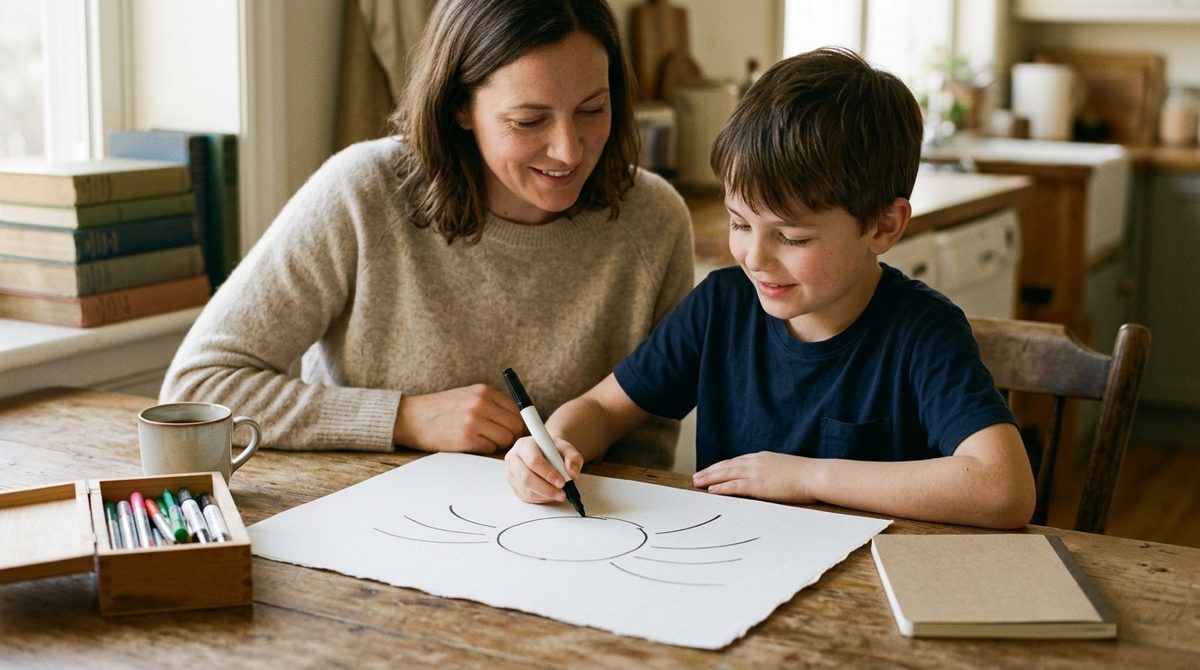
1. Turn the paper sideways
Landscape gives branches room to spread left and right. Portrait squeezes them and pushes kids into writing lists down the page.
2. Draw a big center
Make the central circle large and leave it empty. Let the child write or draw the topic. Owning the center is what makes the map theirs.
3. Draw thick branches with gaps between them
Use a marker, not a pencil, so the branches read clearly. Space them evenly and leave a gap between each so ideas don’t crowd into each other.
4. Leave the ends open
Instead of drawing a closed bubble at the end of every branch, leave some ends as open lines. An open line invites the child to keep going; a closed bubble suggests the answer has to fit inside it.
5. Use one color per branch, if they want
Colors help kids tell branches apart and remember them later. Offer a few crayons, but don’t require it. A map in one pencil is still a map.
A worked example: Maya’s report on frogs
Here is how a single session might go. Maya is nine and has a one-page report on frogs due on Friday. It’s Tuesday evening, and she has a library book and a blank page she’s been staring at for ten minutes.

Her parent draws a landscape blank with a large center and five branches, then hands her the marker. Maya writes “Frogs” in the middle and draws a lopsided green frog next to it. Then they ask one question per branch, out loud, and she answers in a word or two:
- Where do they live? Maya writes “ponds” and, after a moment, adds a short line off it for “rainforest.”
- What do they eat? “Bugs,” with a drawing of a fly.
- How do they grow? She draws four tiny pictures in a row: egg, tadpole, tadpole with legs, frog.
- Cool facts. “Breathe through skin,” which she found in the library book.
- The fifth branch stays empty. She doesn’t know what to put there, so they leave it.
The map takes about fifteen minutes. The next evening, each filled branch becomes one paragraph: habitat, food, life cycle, a cool fact. Four branches, four paragraphs, and a report that has a shape before she writes a single sentence. The empty fifth branch turns out to be useful too. On Thursday she notices nothing on the map says why frogs matter, writes “they eat pests,” and that becomes her closing line.
Notice what the parent didn’t do: they didn’t label the branches in advance, didn’t fill the empty branch for her, and didn’t correct her spelling on the map. The map is for thinking. Neatness can wait for the report.
Paper or app: when to use a digital blank mind map
For young kids, paper wins. Drawing with a marker is part of the fun, and a printed map can go on the fridge. A screen adds nothing a four-year-old needs.
Older kids and the adults helping them are a different case. A digital map is easier to rearrange when a branch turns out to belong somewhere else, and it doesn’t run out of space. In Mindmap AI you can start from an empty canvas on iPhone, iPad, or Mac, add branches by hand, drag them around freely, and switch to outline view to see the map as a collapsible list, which is a natural bridge from map to written report. The free version saves three maps and syncs them through your own iCloud, with no account to create, which makes it a reasonable choice for a family device.
If you’re a parent or teacher preparing a topic, a MindMap Pro subscription in Mindmap AI can generate a starter map from a topic like “the water cycle” so you can see the main branches at a glance. For kids, though, use that as your own preparation, then hand them the blank. The thinking they do to fill the empty branches is the point. For more structured study maps aimed at older students, see our example mind maps for students.
What to do when a child freezes at the blank page
Even a well-designed blank can stall a child. A few moves usually get them going again.
- Ask questions, don’t give answers. “Where does it live?” or “What’s your favorite part?” gives them a direction without supplying the content.
- Let them draw first. Some kids can picture an idea long before they can spell it. A drawing counts as a branch.
- Fill one branch together. Model the first one out loud, then hand over the marker for the rest.
- Remove branches. If six empty spaces feel like too many, cross two out. A finished three-branch map beats an abandoned six-branch one.
- Stop early. If the energy is gone, put the map away. It will still be there tomorrow, and an unfinished branch often fills itself overnight.
FAQ
What is a blank mind map for kids?
A blank mind map for kids is a simple template with one large central circle and a few empty branches radiating out from it. The child writes or draws a topic in the middle and adds one related idea per branch. It helps children see how a big topic breaks into smaller parts before they write or talk about it.
How many branches should a kids’ mind map have?
For ages four to six, three or four branches is plenty, with space for drawings. Children aged seven to nine can handle four to six branches with room for short sub-branches. Older kids can usually draw their own. If a child seems overwhelmed, reduce the number of branches rather than pushing them to fill every one.
Can young children who can’t write yet use mind maps?
Yes. Pre-writers can draw a picture on each branch instead of writing words, and an adult can add a label underneath if the child wants. The value is in connecting ideas to a central topic, not in the spelling. Drawing-only maps work well for retelling stories, planning a day out, or talking about a favorite animal.
Is it better to print a blank mind map or draw one?
Drawing one by hand is usually better for kids, because it takes two minutes and you can match the number of branches to the child and the task. Printables are handy for a classroom set. Whichever you choose, keep the center large, the branches thick, and avoid pre-labeling them so the child decides what goes where.
Turn any idea, article, or URL into a beautiful mind map.
Mindmap AI — Type a topic, paste a long text, or drop in a URL — Mindmap AI reads it and builds a complete, beautifully organized mind map on an infinite canvas.
Download Mindmap AIfree on the App StoreKeep reading

GATE 2027 Study Plan: How to Prepare in 5 Steps
GATE 2027 study plan after the November 2026 registration extension: map the syllabus, rate topics, weight by weakness, and schedule mocks. Worked example.

How to Get a Good Summary of a 60-Page Lecture PDF
How can you get a good summary of a 60-page lecture PDF? Split it into chunks, summarize from memory, then join them into one map. Full workflow.

Mindmap Mac Kostenlos: Free Mind Mapping on a Mac
Looking for a mindmap on Mac, kostenlos? Compare four free options, use a four-point checklist, and see a 40-minute worked example with no budget.