How to Revise for GCSE Science: A Six-Week Method
How to revise for GCSE science: map the specification, test from a blank page, drill past papers, practicals and maths. Includes a six-week mock plan.
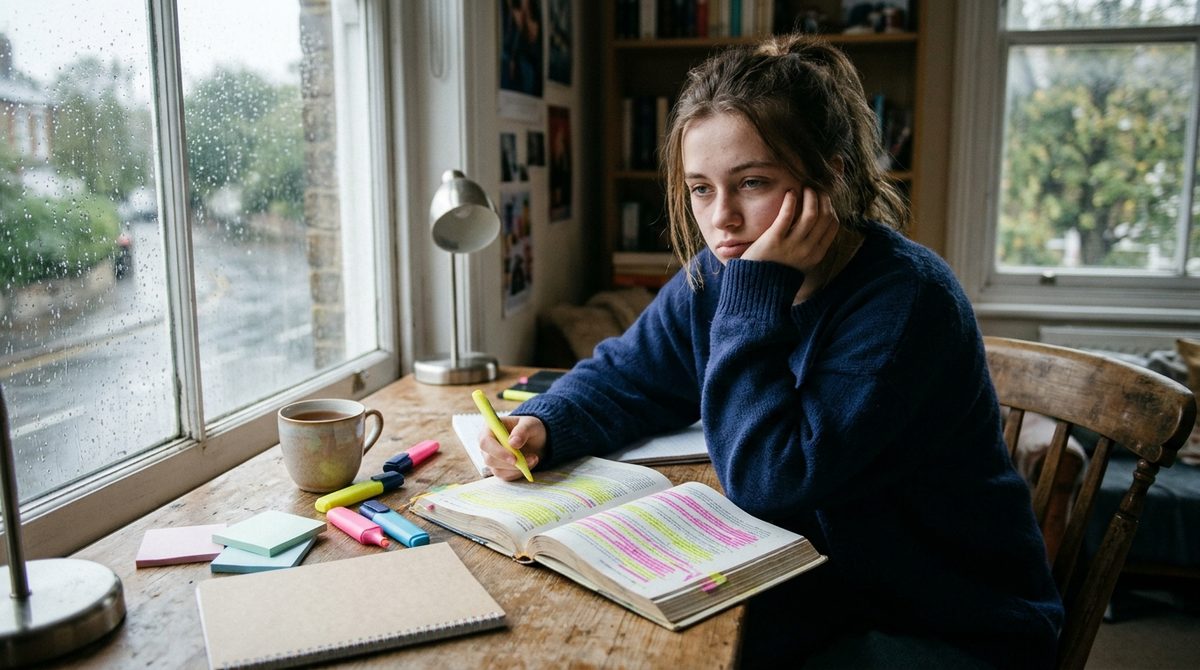
To revise for GCSE science, break each subject into the topics on your exam board’s specification, test yourself on every topic from a blank page before you reread anything, and spend most of your time on past-paper questions, especially the required practicals and the maths. Reading your notes over and over feels productive, but it’s the weakest way to spend the hours you have.
GCSE science is hard to revise for because of its size, not because any one idea is impossible. Whether you sit Combined Science or the three separate sciences, you’re covering biology, chemistry and physics at once, and each has its own kind of question: long explanations in biology, calculations and equations in chemistry, rearranging formulas in physics. A plan that treats all three the same way wastes time.
This guide covers why the usual approach falls short, a six-step method that works for all three sciences, a worked example of one student’s six weeks before mocks, how to handle the practicals and the maths, and a short FAQ.
Why rereading the textbook doesn’t work for science
Most students revise science by working through the revision guide from page one, highlighting as they go. It runs into the same problems every time.
- You never reach the end. The guide is ordered by topic, so the first chapters get revised three times and the last physics topics get skimmed the night before.
- Recognition feels like knowing. Reading a paragraph on the stages of mitosis and nodding is not the same as writing them out in order under exam conditions.
- The connections stay hidden. Energy shows up in respiration, in exothermic reactions and in power calculations. Revised as separate pages, it becomes three facts instead of one idea seen from three angles.
- It skips the marks that are easiest to win. Exam boards must give a share of marks to practical skills and to maths. A student who reads the content but never practises a graph or a rearrangement leaves those marks behind.
The well-known review of study techniques by Dunlosky and colleagues (2013) rated practice testing and spaced practice as the most useful methods, with rereading and highlighting among the least useful. Everything below is built on those two.
How to revise for GCSE science: the method
You need your exam board’s specification for each science, the list of required practicals, a pile of past papers with mark schemes, and blank paper. Check whether you’re on Foundation or Higher tier, because the specification marks which content is Higher only.

1. Turn the specification into one map per science
Put biology, chemistry and physics at the centre of three separate maps. Add one branch per specification topic (cell biology, bonding, electricity and so on) and the key ideas under each. This is your checklist, and seeing a whole science on one page tells you honestly how much is left. If you have the specification as a PDF or web page, Mindmap AI can draft the first version of each map from the pasted text or a link, and you spend your time checking it against the official list instead of drawing boxes.
2. Rate every topic before you study it
For each branch, write what you remember on blank paper or answer two past-paper questions, then mark the topic red, amber or green. Red means you’d drop most of the marks. Green means you could explain it without notes. Do this for all three sciences in the first week, so you’re revising what you don’t know rather than what comes first in the book.
3. Revise with a blank page, not a highlighter
Pick a red topic. Spend ten minutes reading the notes, close them, and write everything you can: definitions, equations, labelled diagrams. Check against the notes and fill the gaps in a second colour. The gaps are your revision for the next session. Our comparison of active recall vs rereading notes explains why this beats reading the same page twice.
4. Give each science its own kind of practice
Biology rewards precise wording, so practise six-mark answers and compare them line by line with the mark scheme. Chemistry rewards method, so practise moles, balancing equations and reacting-mass calculations until the steps are automatic. Physics rewards equations, so learn each one with its units and rearrange it in every direction.
5. Space each topic across weeks
Come back to every red topic after a day or two, again after about a week, and again a couple of weeks later. Each return is a short blank-page test, not a full re-study. Mix sciences within a single evening so you don’t spend three hours in one subject.
6. Finish every week with exam questions
End each week with a set of mixed past-paper questions, marked strictly. Every mark you drop goes back onto your maps as a note on the branch it belongs to. Over a few weeks the maps stop being a summary of the textbook and become a record of exactly where you lose marks.
A worked example: six weeks before science mocks
Amira is in Year 11, sitting Combined Science at Higher tier. Her mocks start in six weeks, with one biology, one chemistry and one physics paper. She can give science about five hours a week alongside her other subjects.

Week 1 — the inventory. She builds three maps from the specification and rates every topic. Of 18 topics in total, she marks 6 red, 7 amber and 5 green. Four of the reds are chemistry: quantitative chemistry, chemical changes, energy changes and rates of reaction.
Weeks 2 and 3 — the reds. She does two 45-minute sessions on each red topic, a few days apart. Each session starts with a blank-page brain dump and ends with eight to ten exam questions. On quantitative chemistry she scores 9 out of 22 on the first set of questions and 16 out of 22 on the second, because the second session went entirely on moles calculations.
Week 4 — the ambers and practicals. One session per amber topic, plus a session going through the required practicals for each science, writing the method, the variables and one source of error from memory for each.
Week 5 — full papers. One timed paper per science across the week. Physics goes well. Biology costs her marks on two six-mark questions where her answer was correct but missed the key terms the mark scheme wanted, so she adds those terms to the relevant branches of her biology map.
Week 6 — light review. Short blank-page tests on every branch still marked red or amber, about 20 minutes a day, and no new content. She keeps the maps in Mindmap AI on her iPhone and uses the collapsible outline view on the bus: collapse a branch, say the contents aloud, expand to check. The maps sync through iCloud, so they’re the same ones she edits on the family iPad at home.
Total time across six weeks is around 30 hours, and very little of it is reading.
Required practicals, maths and other edge cases
- Required practicals. Questions on them can appear anywhere, and they often ask about variables, control measures, risks and how to improve accuracy. Give each practical its own small branch with those four headings. You don’t need to have done the experiment perfectly in class, but you do need to describe it.
- The maths. Physics carries the most maths, then chemistry, then biology. Practise rearranging equations, converting units, standard form and reading gradients from graphs. Check whether your board provides an equation sheet for your exam year, and learn any equation that isn’t on it.
- Six-mark questions. Plan them in thirty seconds: three or four points in a logical order, each using a specific scientific term. Mark schemes reward a clear sequence more than a long answer.
- Separate sciences. If you’re taking biology, chemistry and physics as three GCSEs, there is more content and longer papers, so start the inventory earlier and build one map per science per paper.
- Too many subjects at once. Science is one of several GCSEs competing for your evenings. Our guide on making a revision timetable that works shows how to fit topics from every subject into one plan with spare sessions built in.
FAQ
When should I start revising for GCSE science?
Start the inventory and ratings at least two to three months before your exams, and earlier if you’re taking the three separate sciences. That gives you time to visit every weak topic several times with gaps in between. Starting a few weeks before means each topic gets one pass, which tends to fade by the exam.
Is it better to revise from a revision guide or past papers?
Use both, but give past papers the larger share. A revision guide is useful for checking content and filling gaps after a blank-page test. Past papers and mark schemes show you how questions are worded and what earns marks, which is the part most students underestimate until the mocks.
How do I revise for GCSE science six-mark questions?
Practise them under time pressure, then compare your answer with the mark scheme line by line. Note the key terms and the order of points the examiners expected, and add them to your notes for that topic. Before writing, plan three or four points in a logical sequence so the answer reads as one connected explanation.
How many hours a day should I revise GCSE science?
There’s no fixed number, and quality matters more than hours. Two or three focused 45-minute sessions a week per science, each ending with exam questions, will do more than a long evening of rereading. Increase the time as exams get closer, but keep the sessions short and spaced across the week.
Turn any idea, article, or URL into a beautiful mind map.
Mindmap AI — Type a topic, paste a long text, or drop in a URL — Mindmap AI reads it and builds a complete, beautifully organized mind map on an infinite canvas.
Download Mindmap AIfree on the App StoreKeep reading

GATE 2027 Study Plan: How to Prepare in 5 Steps
GATE 2027 study plan after the November 2026 registration extension: map the syllabus, rate topics, weight by weakness, and schedule mocks. Worked example.

How to Get a Good Summary of a 60-Page Lecture PDF
How can you get a good summary of a 60-page lecture PDF? Split it into chunks, summarize from memory, then join them into one map. Full workflow.

Mindmap Mac Kostenlos: Free Mind Mapping on a Mac
Looking for a mindmap on Mac, kostenlos? Compare four free options, use a four-point checklist, and see a 40-minute worked example with no budget.