How to Read a Bedtime Story Aloud So It Calms Kids Down
How to read bedtime stories aloud so kids wind down: pace, volume and pauses, a step-by-step routine, and what to do on nights you have no voice left.
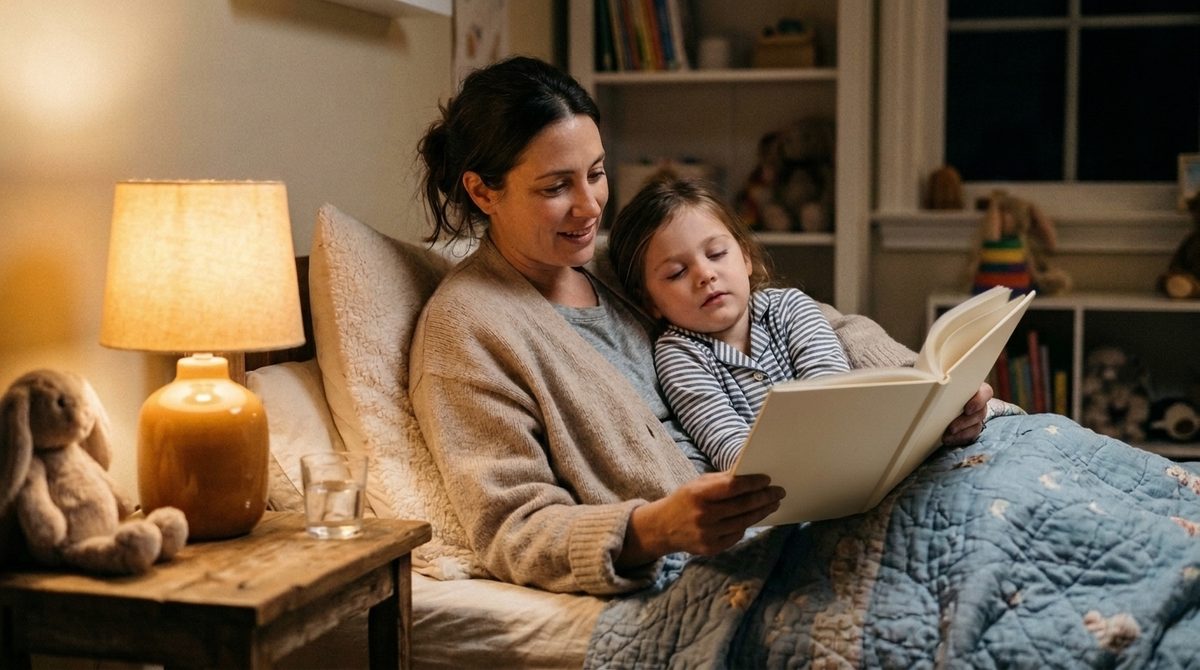
To read a bedtime story aloud so it calms your child down, start at a normal, warm pace, then gradually slow down, lower your volume and lengthen your pauses until the last lines are close to a whisper. Your voice does as much work as the words. A perfectly chosen story read briskly can wind a child up; an ordinary story read slowly can put them to sleep.
Most read-aloud advice is written for daytime: big voices, lots of expression, keep them engaged. Bedtime is different. You want your child engaged at the start and drifting by the end, and that means your delivery has to change as the story goes.
Here's how to do it, step by step, plus a version for the nights when you're too tired to read anything, a worked example with two kids of different ages, and what to do when the read-aloud keeps getting derailed.
The three things that matter: pace, volume and pauses
You don't need acting skills. You need control over three things.
- Pace. Most parents read too fast, especially when tired, because finishing feels like the goal. At bedtime, slower is better. Aim for a pace where you could comfortably point to each word.
- Volume. Start at a normal indoor volume so your child can follow easily. Drop a notch at each new page or section. By the end, you should be speaking softly enough that the room feels hushed.
- Pauses. A pause at the end of a sentence gives a young child time to picture what just happened. Pauses also slow your breathing, and children tend to match the rhythm of the person reading to them.
If you remember only one thing: your voice should model winding down. The story is the vehicle, but the slowing is the message.
How to read bedtime stories aloud, step by step
1. Settle before you start
Lights low, teeth done, water by the bed, child already lying down or tucked against you. Starting a story while bedtime tasks are still pending invites "I need a drink" in the middle.
2. Choose a story that ends calmly
Excitement in the middle is fine. The ending has to be quiet: the hero home, safe and sleepy. If a book ends on a big joke or a cliffhanger, save it for daytime.
3. Read the first page at normal speed
Your child needs to understand who the hero is and what's going on. Clear, warm, ordinary pace.
4. Use fewer character voices than you would during the day
One or two voices can help a young child follow who's talking. A full cast of silly voices is fun, but it raises energy. If your child loves voices, use them in the first half and let them fade as the story calms.
5. Slow down and drop your volume as the story progresses
Every page, a little slower and a little softer. Lengthen the pauses. Read the final paragraph almost at a whisper.
6. Let early readers follow the words
For children starting to read, run your finger under the words occasionally, or let them read a repeated phrase. Keep it light; bedtime isn't a reading lesson.
7. End with one quiet line and lights out
If the story has a lesson, say it once, softly. Then a goodnight phrase you use every night. The ritual of the same closing words tells the body it's time to sleep.
The tired-parent version: when you have no voice left
Some nights, reading aloud for ten minutes is more than you have. You've been talking all day, you're losing your voice, or you're putting two kids down in two rooms. On those nights, it's fine to let something else do the narrating, as long as it's calm and you stay close.
GooDream can read its stories aloud. You create a personalized story (your child's name, their age, a value like courage or patience, and a favorite thing), then tap play. You can pick a narrator voice — warm, soft, gentle or playful — adjust the reading speed, add quiet background music, and set a sleep timer so the narration fades out after a set number of minutes in case your child falls asleep early. The words highlight as they're read, which early readers enjoy following along with.
The trade-off is real: a narrator, however gentle, isn't you. The best use is as a backup, not a replacement. Even on narrated nights, sit with your child, turn the screen away from their face, and say the goodnight line yourself. Our guide on bedtime stories versus screen time at night covers how to keep a phone from becoming the main event.
A worked example: one story, two ages
Take a common setup: a four-year-old, Sam, and a seven-year-old, Lily, sharing a room. Lily wants a "real" story; Sam loses interest after three minutes.
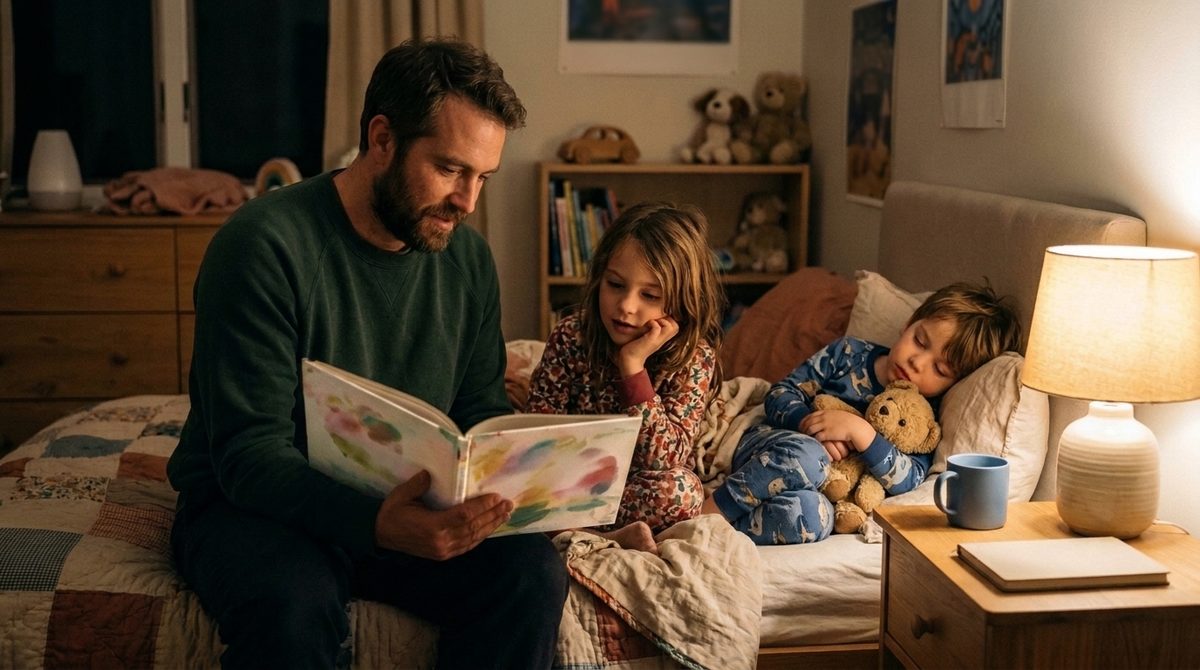
8:00 — Both in bed, lights dimmed. You choose a story about a lighthouse cat that has a small adventure and ends with the cat curled up in the warm lamp glow.
8:01 to 8:03 — First third at normal pace. Lily reads the cat's repeated line ("All boats safe, all lights on") each time it comes up. Sam's job is to make the sound of the waves. Both are involved, neither is wound up.
8:03 to 8:06 — Middle section, slower. You drop the waves and the character voices. Sam's eyes are getting heavy.
8:06 to 8:08 — Final section nearly whispered, long pauses. You skip any extra description so the ending arrives while Sam is still awake enough to hear it.
8:08 — One question for Lily, quietly: "What do you think the cat dreams about?" Then your goodnight line and lights out.
Ten minutes total, and the pacing did most of the work. If you'd used GooDream for this, you might generate a shorter story for a night like this and pick the softest narrator voice, with Lily following the highlighted words on the screen held by you.
When the read-aloud keeps getting derailed
Your child interrupts constantly
Questions during a story are good for language, but at bedtime they can stretch twenty minutes. Try "Let's hold that question until the end," and actually answer it at the end. Children stop interrupting when they trust the answer is coming.
They want the same story every night
That's normal and healthy; repetition is comforting and helps young children build language. Read it again, as slowly as ever. If you're losing your mind, alternate the favorite with one new story. Saving favorites in a story library makes this easier.
They want "just one more"
Set the number before you start. "Two stories tonight, then lights out." If you're using narration, a sleep timer sets the limit for you, which takes the negotiation off your shoulders.
An older child wants to read it themselves
Let them, but swap roles at the end: they read the first half, you read the last few lines slowly. That keeps the wind-down in your voice. If you want more on why this matters long-term, see our piece on the real benefits of reading to your child.
FAQ
How long should I read aloud at bedtime?
About five to ten minutes for most children, and three to five minutes for toddlers. It's better to read one short story slowly than a long one quickly. If your child is still wide awake at the end, the problem is usually pace or a too-exciting ending, not the length.
Should I do different voices for each character?
A couple of voices help young children follow who's speaking, but a big performance raises energy. Use voices early in the story and let them fade as you approach the end, so the last part is in your own soft, slow voice.
Is it okay to let an app read bedtime stories aloud?
Yes, on nights when you can't, as long as the narration is calm and you stay with your child. GooDream can narrate its personalized stories with a choice of gentle voices, adjustable speed, background music and a sleep timer. Keep your own goodnight ritual so the closeness stays yours.
At what age should you start reading bedtime stories aloud?
You can start from birth. Babies benefit from the sound and rhythm of your voice long before they follow a plot. Around two, children start following simple stories, and by three or four most can enjoy a short story with a beginning, a small problem and a sleepy ending.
Personalized AI bedtime stories that lull little ones to sleep.
GooDream — GooDream writes a gentle, personalized bedtime story in seconds — starring your child's name and their favorite theme.
Download GooDreamfree on the App StoreKeep reading
Bedtime Stories About Kindness: 8 Ideas and How to Tell Them
Bedtime stories about kindness that actually land: 8 premises to tell tonight, how to show the lesson without preaching, and stories for hard situations.
Bedtime Stories for 5 Year Olds: Length, Themes and Ideas
Bedtime stories for 5 year olds: how long they should be, the themes that land at this age, 8 ideas built around school and friends, and a worked example.
Bilingual Bedtime Stories: Raising Kids in Two Languages
Bilingual bedtime stories that keep a home language alive: four approaches, what to do when kids answer in English, and how to keep new stories coming.